
What the Plants Left Behind
Downloads from an ayahuasca ceremony.

Things I jotted down in my notebook while on a recent plant medicine weekend…
Lessons
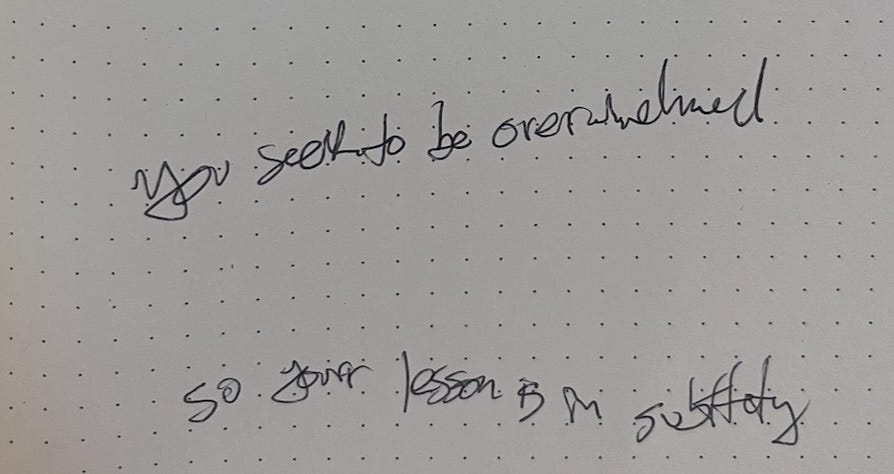
🌱 You seek to be overwhelmed so your lesson is in subtlety.
🌱 Effort is the tax you pay for the outcome you desire.
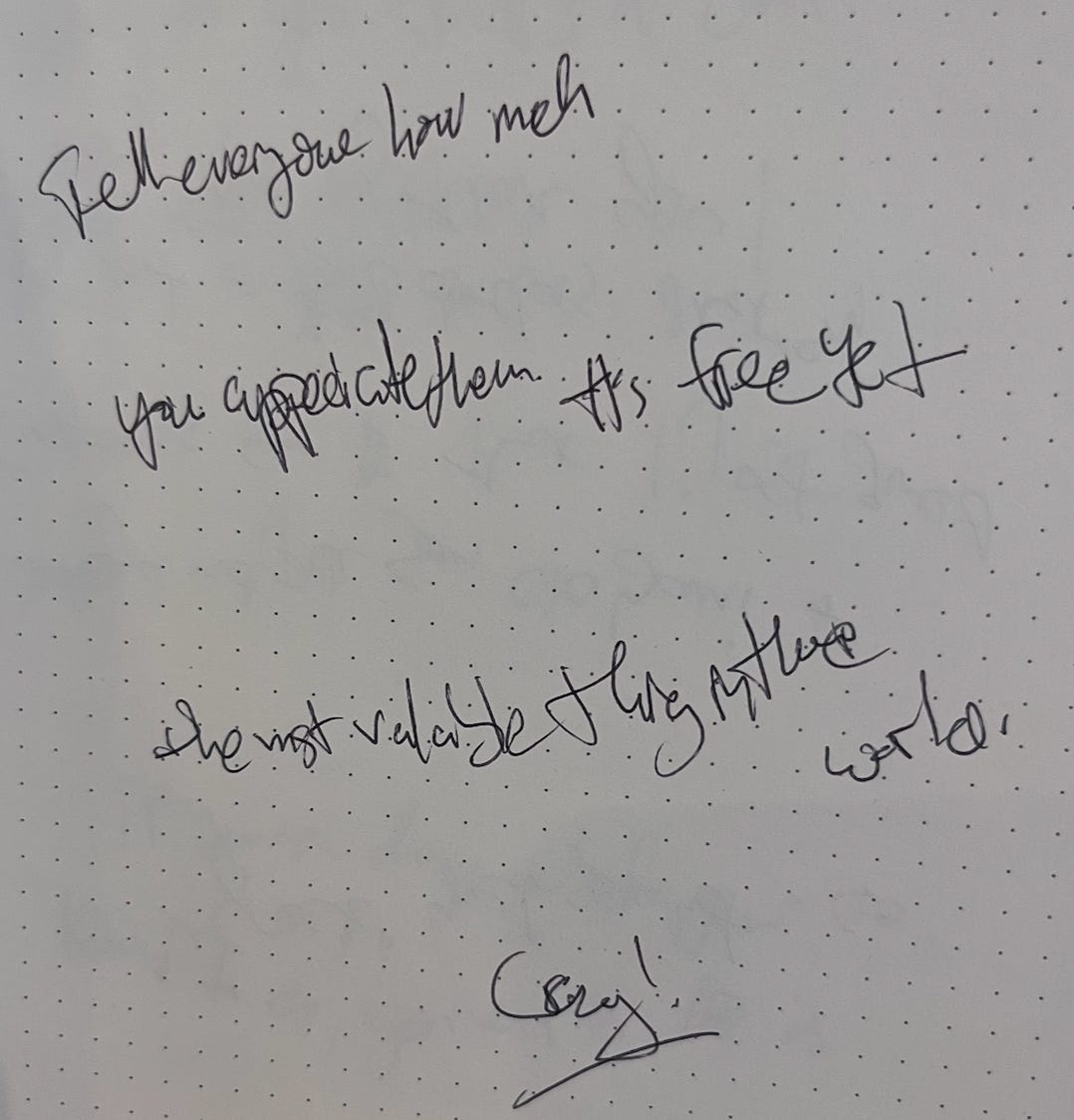
🌱 Tell everyone you love how much you appreciate them. It’s free yet still the most valuable thing in the world. Crazy.
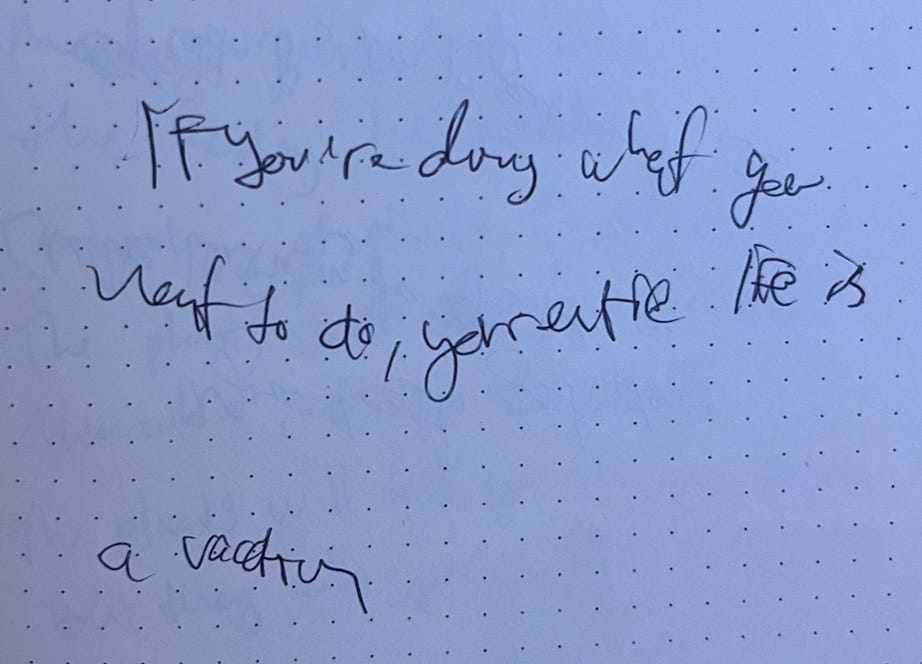
🌱 If you’re doing what you want to do, your entire life is a vacation.
Wounds
🌱 Your past will eat up your bandwidth until you process it. It’s like those files that take up all your iPhone storage. Purge and you will gain capacity.
🌱 “Find somebody’s struggle and you will find the plot.”
-Brandon Stanton
🌱 You can be lucky and still have a wound. After all, we are all wounded; the strength comes from processing it. Weave a crown from the weeds.
The wounded healer theory, coined by psychiatrist Carl Jung, is an archetype suggesting that a therapist’s or helper’s own personal struggles, trauma, or pain become the very source of their ability to help others heal. Vulnerability transforms into profound empathy, allowing them to deeply connect with patient suffering.
Parenting
🌱 My mom had a roomful of masks…in every way. She also loved discussing dreams. She was a translator. The job was translating myths into truths. And now it’s mine. They never tell you nepo baby can break this way too.
🌱 A family is a dictatorship ruled over by its sickest member (by me). Excerpt:
Originally, the “dictatorship” line seemed to me a statement on individual dysfunction. But as time has passed, I’ve come to see it as a reveal of what it means to be a family. The phrase isn’t about the sick person, it’s about how everyone else rallies around them and makes it work. It’s an acknowledgement of the relationship between family and friction. The obstacles are the point.
🌱 We spend our lives dancing around the pain instead of confronting it. There’s a wounded, small voice crying for help and protection. And most of us gag it with “behavior modification.”
Body
🌱 The mind refuses to believe the body has a lot of the answers. What an egomaniac.
🌱 Drop into sensation. Don’t grip. Stop thinking and feel it.
🌱 It’s not about words. It’s not about words. It’s not about words. It’s not about words. It’s not about words. It’s not about words. (Had to write that down.)
Advice
🌱 If you desire visitors, build as many bridges to your island as possible.
🌱 All those guys who keep gambling all the time: Just do drugs. Do. The. Drugs. What you really love is dopamine. And, at this point, drugs are actually a wiser path to obtaining it.
🌱 Can someone please tell everyone to stop crying so much and just be thankful for being alive?
🌱 But also…
“Live to the point of tears.”
-Albert Camus
Weeping may be the closest experience human beings have to an experience of enlightenment. Because in weeping, you’ve given up. You’ve broken down. Whatever control you wanted over the world has slipped out of your hands. Whatever way you wanted to keep heartbreak at bay, whatever way you wanted to keep grief at bay, those perimeters have all been broken down by the grief, the loss, the person leaving you, by the diagnosis you’ve just been given in the hospital. You’ve actually dropped down below this perimeter, and it breaks apart through that overflow of emotions.
The reason you’re weeping is because you haven’t built a body that can hold that revelation, but now you’re just about to do it. You’re breaking open this controlled edge that you’ve had. You’ve surrounded it, and it’s breaking out of there. You’re actually becoming larger through the weeping…
That’s an invitation to feeling everything as much as you can feel it all the time, in beauty and in sorrow. Don’t hide it from yourself. Don’t just try and feel everything. It’s because we’re afraid of the consequences of feeling that we won’t allow it.
🔌 This is human stuff made by a human who likes to eat food and your support helps buy that food so maybe you can sign up for the paid plan and you’ll be rewarded with bonus content, access to the archives, and the knowledge you’re helping make this all happen.
Plants
🌱 The plants will eat us in the end. Meanwhile, we eat the plants.
🌱 There is technology in robots and chips. But there is also technology in plants, religion, and ancient wisdom.
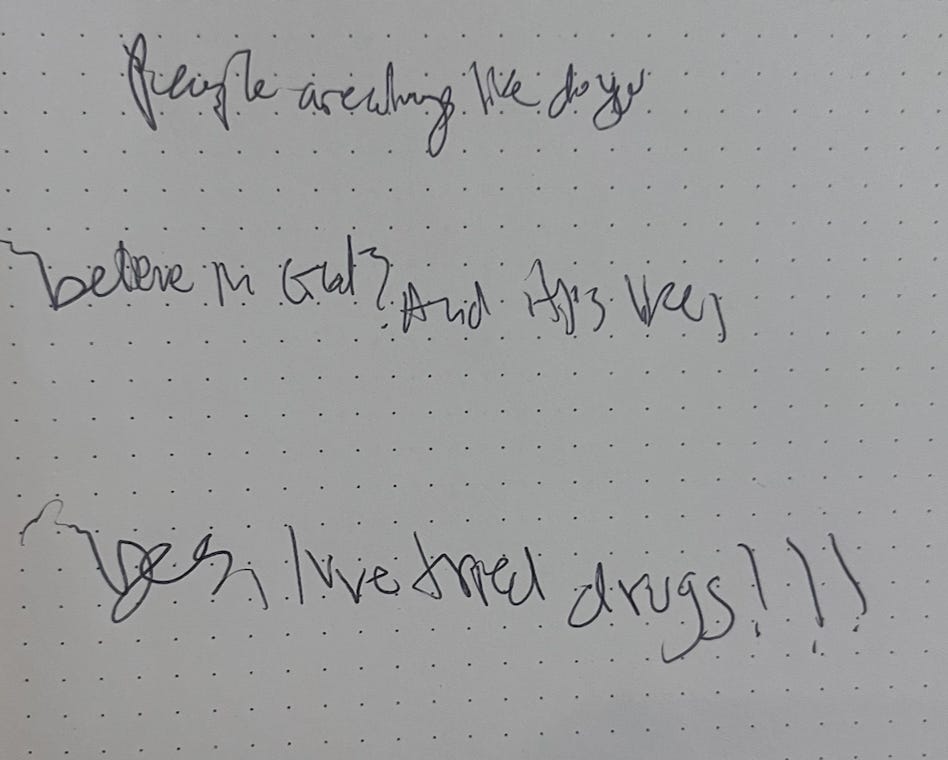
🌱 People are like, “Do you believe in God?” And it’s like: “Yes, I’ve done drugs.”
🌱 The plants will tell you if you listen. But they whisper.
Zen
🌱 “Love everybody, serve God, and tell the truth” is one of the most famous teachings Ram Dass received from his guru, Neem Karoli Baba.
🌱 My entry point to Buddhism was the book “Buddhism Plain and Simple” by Steve Hagen. Read it decades ago. This excerpt rocked my world and has remained top of mind ever since:
Pick up a flower-- a beautiful, living, fresh rose. It smells wonderful. It reveals a lovely rhythm in the swirl of its petals, a rich yet dazzling color, a soft velvety texture. It moves and delights us.
The problem with the rose is that it dies. Its petals fall; it shrivels up; it turns brown and returns to the earth.
One solution to this problem is to ignore the real rose and substitute a plastic one, one that never dies (and never lives). But is a plastic rose what we want? No, of course not. We want the real rose. We want the one that dies. We want it because it dies, because it’s fleeting, because it fades. It’s this very quality that makes it precious. This is what we want, what each of us is: a living thing that dies.
Talk talk
🌱 Nonviolent Communication (NVC):
1. Observations (What is happening): State the concrete, factual events you observe without adding criticism or evaluation.
Instead of: “You are always ignoring me.”
Try: “When I see you looking at your phone while I’m speaking...”
2. Feelings (What you are experiencing): Identify and express your actual emotions (e.g., hurt, frustrated, joyful) rather than thoughts about what the other person is doing.
Try: “...I feel hurt and frustrated...”
3. Needs (What is missing): Connect your feelings to your underlying universal human needs (e.g., respect, connection, support).
Try: “...because I have a need to feel valued and heard in our conversations.”
4. Requests (What you want to happen): Ask for a specific, actionable, and positive behavior that enriches your life, framed as an opportunity rather than a demand.
Try: “Would you be willing to put your phone down and give me your full attention when we talk?”
🌱 “Radical honesty.” Eh, you can just put radical in front of anything. Forgiveness, confusion, salesmanship, etc. Radicalize everything because why not?
🌱 Seinfeld on the two voices you need to write well:
The key to writing, to being a good writer, is to treat yourself like a baby, very extremely nurturing and loving, and then switch over to Lou Gossett in Officer and a Gentleman and just be a harsh prick, a ball-busting son of a bitch, about, “That is just not good enough. That’s got to come out,” or “It’s got to be redone or thrown away.”
So flipping back and forth between those two brain quadrants is the key to writing. When you’re writing, you want to treat your brain like a toddler. It’s just all nurturing and loving and supportiveness. And then when you look at it the next day, you want to be just a hard-ass. And you switch back and forth.
Music
🌱 I once did a hilltrek tribe in northern Thailand. Every person in that tiny remote village had the most beautiful singing voice. How? No one there ever said, “I need to learn how to sing.” They just knew. Maybe that’s what living with circadian rhythms does to you. I imagine it’s the same in the Congo with dance. Everyone there knows how to move their body to the music. The lesson: You don’t need to learn how to dance. You need to forget how to not dance.
🌱 You have to let it go. John Lennon nailed it in “Watching the Wheels”:
People say I’m lazy
Dreaming my life away
Well they give me all kinds of advice
Designed to enlighten me
When I tell them that I’m doing fine watching shadows on the wall
“Don’t you miss the big time boy, you’re no longer on the ball?”
I’m just sitting here watching the wheels go round and round
I really love to watch them roll
No longer riding on the merry-go-round
I just had to let it go
🌱 Real community is a tapestry. It’s woven threads that turn isolated weakness into collective strength and safety. And diversity is baked into the experience. Like an orchestra, it all fits together. Play your instrument, do your part, and harmonize with your partners.
🌱 Singing: The Key To A Long Life by Brian Eno.
I believe that singing is the key to long life, a good figure, a stable temperament, increased intelligence, new friends, super self-confidence, heightened sexual attractiveness and a better sense of humor.
Behind the paywall
More plant downloads, a couple of rants, and wise words from the Gene Keys, Pema Chodron, Fiona Apple, and Peter Gabriel.
