
The 3/30 rule
We keep taking things that are only 3% of our society and behave as if they’re 30%.

The chasm between the vibes in NYC right now and the violence shown on social media is wild. “Spurs fans are getting attacked on the streets!” Maybe somewhere that happened, but it ain’t what anyone I know is seeing.
In reality, the city is filled with joy and unity right now. On game nights, strangers are high fiving each other on the streets. Incredible positive energy. Yet social media would lead you to believe the whole town is a Worldstar orgy of violence.
Let that be a lesson for all of us re: reality vs. the algorithm. So often, IRL is fine yet these platforms want us to believe mayhem rules.

It’s 3%, not 30%
Reality doesn’t get clicks. So we have to inflate it. It’s something I refer to as the 3/30 rule.
You know the Pareto Principle (often called the 80/20 rule), right? It’s the observation that roughly 80% of outcomes come from 20% of causes.
Well, the 3/30 rule is about how we keep parading outliers as if they’re the mainstream. (Call it The Ruby Rule if you like.)
It’s how we take things that are only 3% of our society and behave as if they’re 30%. (The numbers may vary, but you get it).
It’s not that these things don’t exist at all. It’s that we inflate them to an outsized role that doesn’t align with the facts on the ground. Are all Zionists monsters? Are all Muslims terrorists? You know the answer. Yet all we get online are absolutes.
The algorithm keeps elevating those on the fringe because we are more likely to engage with them. Whether we hate or fear them, we find them fascinating. Click. Click. Click.
When the thin slice becomes the story
Are trans women competing in women’s sports? I mean, once in a while. But on the regular? Nah. Does it deserve the bandwidth we give it? Of course not.
Is there fraud in Minnesota? Sure. Is every Somali person there crooked? Please.
It’s happening with disorders too. Sure, some people have brain chemistry issues. But let’s be real: It’s nowhere near as common as the internet would have us believe. Yet TikTok self-diagnosing and Big Pharma propaganda has us believing 30% of us are disordered.
Do some Dems wanna “defund the police” and murder health care execs in the streets? A tiny percentage but not whatever FOX News is claiming. Socialism? C’mon, even Elizabeth Warren is a capitalist. Are Joe Rogan fans all conspiracy kooks? Nah, the vast majority just like MMA or comedy.
The Libs of TikTok are easy to attack but they ain’t the mainstream of the left. Likewise, the Oath Keepers are abominable, but they don’t speak for the core of GOP voters.
The real danger is in how much we believe the hysterical hype:
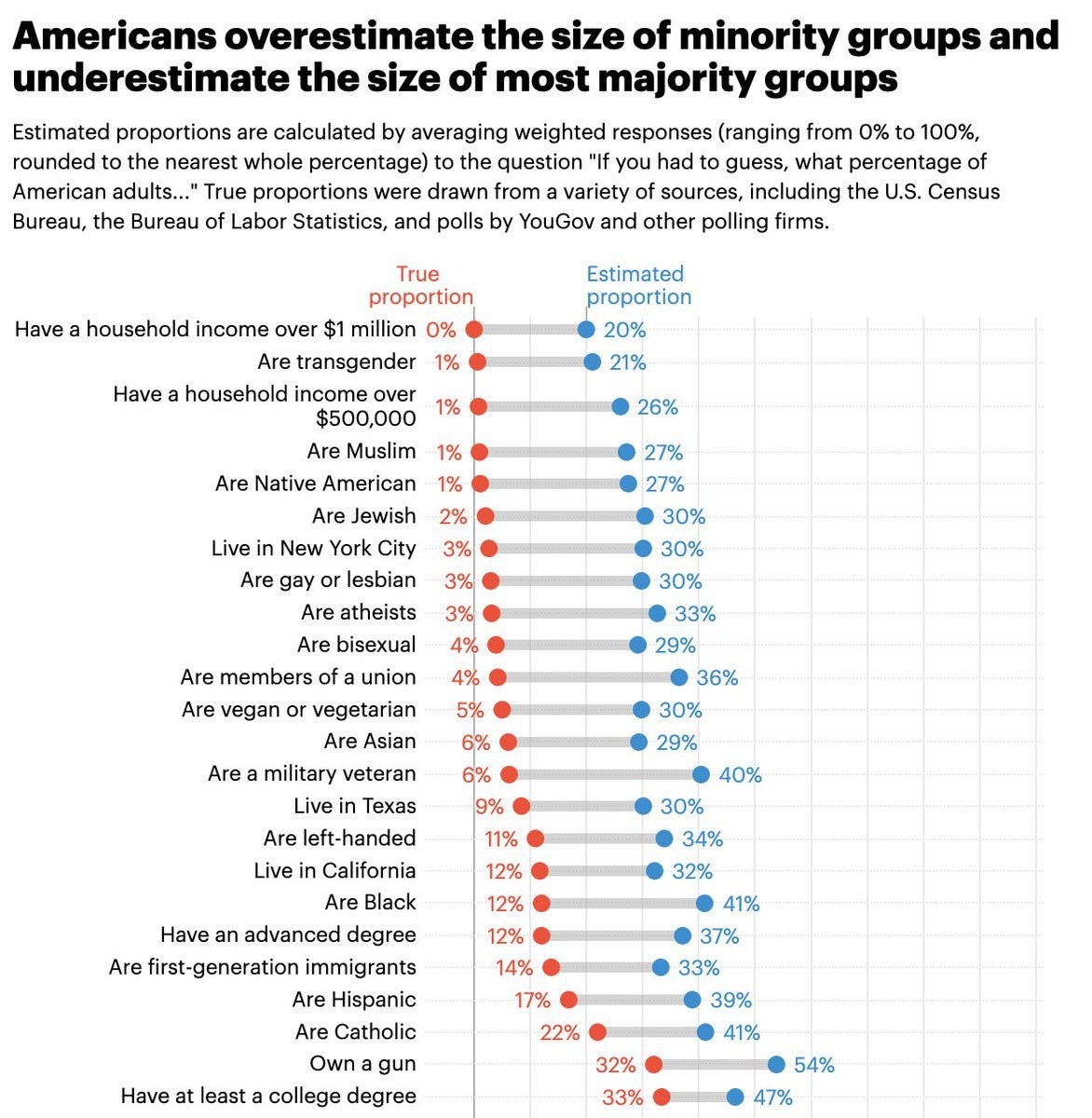
Everything online must be inflated
It started innocently enough with “LOL.” Someone said something vaguely humorous and, although it didn’t make us smile, let alone guffaw, we began reporting that we were, in fact, laughing out loud.
Eventually that lie wasn’t enough so we upgraded to “ROTFL.” We were laughing so hard we were rolling on the floor!? Since compliments are like any other drug, we built up a tolerance. And that’s when we turned to the face with tears of joy emoji. What a hoot! I’m crying. 😂😂😂
Except we weren’t laughing at all.
Same with selfies. People started posting photos of themselves looking fine or slightly better than normal. Nonetheless, we told them they were “Gorgeous.” Eventually, that became “Queen!” And when that wasn’t enough, we started typing, “Goddess!!!”
We inflate everything so much that it’s become easy to forget reality. The timeline has hypnotized us.
We’re to blame too. The algorithm knows we’re obsessed with the fringes and bored with the mundanity of reality. And those who wield power know they can use these issues as misdirections. Trans bathrooms? That’s what a magician does when they’re trying to hide something else they’re doing.
Is [insert subject matter] based in reality? Sure, technically. But is it being wildly exaggerated in order to monetize and manipulate people? You bet.
Watch out for them tricking you into thinking the sliver is actually a chunk.
Comedy
NYC: Mood Board returns to Gospel on Thursday, June 11. Promo code JOY20 gets you discounted tickets.

🔌 Go paid and you’ll get bonus stuff and help support the cause. Thanks.
5-spotted
🗯️ Yair Rosenberg: ‘The More I’m Around Young People, the More Panicked I Am’
Americans who are middle-aged or older tend to get their information from legacy media outlets, which, for all their flaws, normally have editorial processes that eschew explicitly racist material. Younger Americans, by contrast, are likely to trust and get their news from lightly moderated social-media platforms, which often advantage the extreme opinions, conspiracy theories, and conflict-stoking content that drive engagement. This bifurcation of information has consequences.
🗯️ Zadie Smith talks about how we often think of freedom as simply being able to do whatever we want, whenever we want.
There’s many other forms of freedom that are actually quite valuable. Much of life can feel like a performance, where you’re trying to fit in, impress, or meet expectations. Even close friendships sometimes have this performative aspect where you’re not fully yourself. So anywhere you can go where you’re not on stage, where you’re not having to keep up someone else’s idea of you, where you can just be yourself—that is freedom. For me, at least—that’s a form of being free that is really valuable to me.
🗯️ There’s an entire genre of media coverage best described as “rich guy has an opinion.”
It’s surprisingly common, and once you notice it you’ll see it everywhere: entire news stories dedicated to the otherwise unremarkable opinion of a rich person, or news stories that fold the opinions of rich people into their otherwise neutral coverage. It’s taken for granted in many newsrooms that a person’s wealth imbues their opinions with newsworthiness…It’s not just that elite opinions are bleeding into press coverage, it’s that they are being treated as news per se. It’s journalism consisting of quotes from rich guys.
🗯️ Jason Fried: You shouldn’t have to learn how to use a house.
You shouldn’t need a tech tour and an app (or five) to turn the heat down or clean the dishes. You shouldn’t have to worry that pressing the wrong button will set off a chain of events you don’t know how to undo. All these powerful processors and thousands of lines of code have succeeded in making everyday things slower, harder to use, and less reliable than they used to be.
🗯️ From the Therapist: “Happy wife, happy life.”
This common phrase, offered as marital advice, can lead to a profound sense of dissatisfaction. It suggests that in service of your wife’s happiness, your own needs are negligible. Of course, taking your partner’s happiness into account is both healthy and necessary in any marriage. But “happy wife, happy life” amounts to a costly bargain: Resentment is the price you eventually pay for abandoning yourself.
Thanks for reading. Go Knicks!
-Matt
Dear Matt,
Fascinating stuff as always.
One quick note: "Libs of TikTok" is an extreme right-wing account.
(I know you say "they ain’t the mainstream of the left," but I don't think they're the example you're looking for here.)
https://en.wikipedia.org/wiki/Libs_of_TikTok
Love you! Thanks for sharing as always!
Myq