
Domingo
Equine therapy meets plant medicine.

We entered the paddock and were told not to approach the horses. Hold your hand out and the horse will give you a nod with his snout, a fist bump of sorts, if he’s open to interacting.
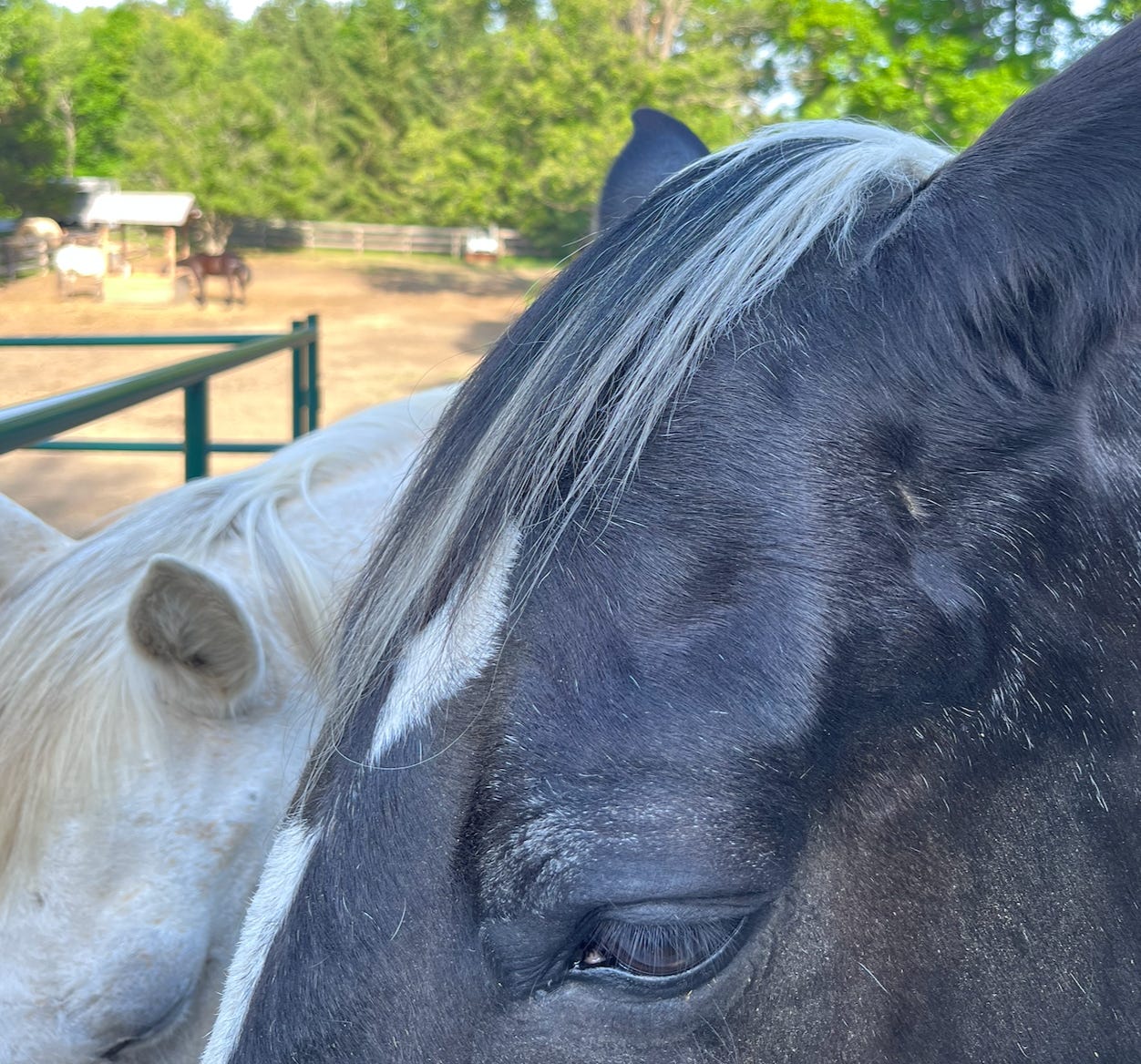
After a few minutes, Domingo moseyed over toward me. He had a brown coat and downcast eyes.
What I knew about Domingo: Before coming to his new home, he’d been a racehorse and then a workhorse for the Amish, who are notorious for grinding horses down by overworking them. He was the newest here and was continually dominated by one of the other horses (who was working through a whole different set of issues).
Domingo seemed guarded but was willing to stay put and let me pet him. I stroked his sides and noticed the twitch of his muscles as he tried to shoo flies from his fur. He gently nudged me with his snout.
S. came over and asked me how I would describe this horse. “Shy and a little bit scared. Still trying to find his place here. But underneath it, I think he’s playful. And that will come out once he’s more comfortable.”
S. replied, “And who does that remind you of?”
I knew the answer before she finished asking. Damn. OK.
I explained how that description sounded like me when I was a kid. Folks now consider me an extrovert, but I wasn’t always that way. With my late December birthday, I was always the youngest in my class. I clammed up in social situations. No one came to my little league games. Nor my high school basketball games. I mean, I wasn’t getting much playing time so why would they?
Plus, my parents weren’t exactly helicopter parents showering me with attention. I tell a joke about how they were more like submarine parents: cold, distant, kept everything under the surface, could go nuclear at a moments notice, etc. An exaggeration based on truth.
At least I was smart, though. That seemed to please my parents. I remember them touting how I was in our school’s gifted and talented program. At ten years old, my grandmother encouraged me to go to Harvard. So OK, be smart. That makes them happy.
The rest? I pushed it down. Or so I thought.
But that’s when I started thinking about my adult life and how I seek attention, especially onstage. I’ve done it thousands of times now (first in a band, later as a comedian). I always smelled the ego in that, so I’ve tried my best to deserve that attention. I’ve tried to make quality stuff. I want to be worthy of people noticing me.
And then there’s women. I took some comfort there, I do declare. A pretty girl on my arm offered a sweet hit of affirmation. However, all that means I’ve spent a lot of life force chasing things that couldn’t (or didn’t) love me back.
I leak energy chasing validation.
“What did that child want?” asked S. I discussed all of that. He wanted to be told he was worthy of attention, regardless of the hoops he jumped through. That he was good enough, deserved love, and it wasn’t his fault that people were sometimes mean to him.
S. suggested I take all that and make it my intention during the plant ceremony that night. To go back and give that child, me, the nurturing parenting he longed for back then.
A few hours later I was on a mat after sipping the tea. When the medicine hit, it was blissful anarchy, a combination of kaleidoscopes, waterfalls, casinos, jungle kisses, doors opening onto other doors, MC Escher ladders turning into each other, spinning rims, and Greek gods. Everything was beautiful and silly. I felt like I was being injected into the cells of a forest root system.
I remembered S.’ advice that you can steer the medicine. You can instruct it to show you what you need. So I went back to that childhood version of myself. Painful data points I hadn’t thought about it in years reemerged from my memory.
It’s strange how much the negative stuff lingers. I used to fake injuries during soccer games, stopping the game so the adults would gather round me.
I would get teased by classmates and face the laughter of my peers. In middle school, an older student brought his dad’s hunting knife to the playground and held it to my throat while his buddies egged him on.
For perhaps the first time in my adult life, I stared down these things. And I saw the child on the other side of them, the scared one wondering, “Do I deserve this? Is there something wrong with me? Is that why this is happening?”
And that’s when I began purging. The bucket caught all that pain and buried fears. I turned to my trusty friend analysis. I tried to examine what was happening. And then I gave up on that.
I realized there was no thinking here. Something stored in my body was leaving. A residue had been scraped loose and was finally washing away. I wasn't discovering an idea. I was ejecting pain. This wasn’t words or ideas, this was body.
Finally, I put the bucket down. I now felt lighter. I imagined myself as a boy and tried telling that kid all the things I wished I had heard. “You are worthy of attention. You deserve praise. Even if you aren’t super smart or talented, you are still lovable and loved. You are doing a good job. Everything is going to work out alright. In fact, so many of your dreams will come true. Just you wait.”
And I had empathy for my parents, too. I also saw them as children and realized how much their parents didn’t give them what they had secretly needed. It’s a chain we carry forward. We all go around spackling holes from our childhood.
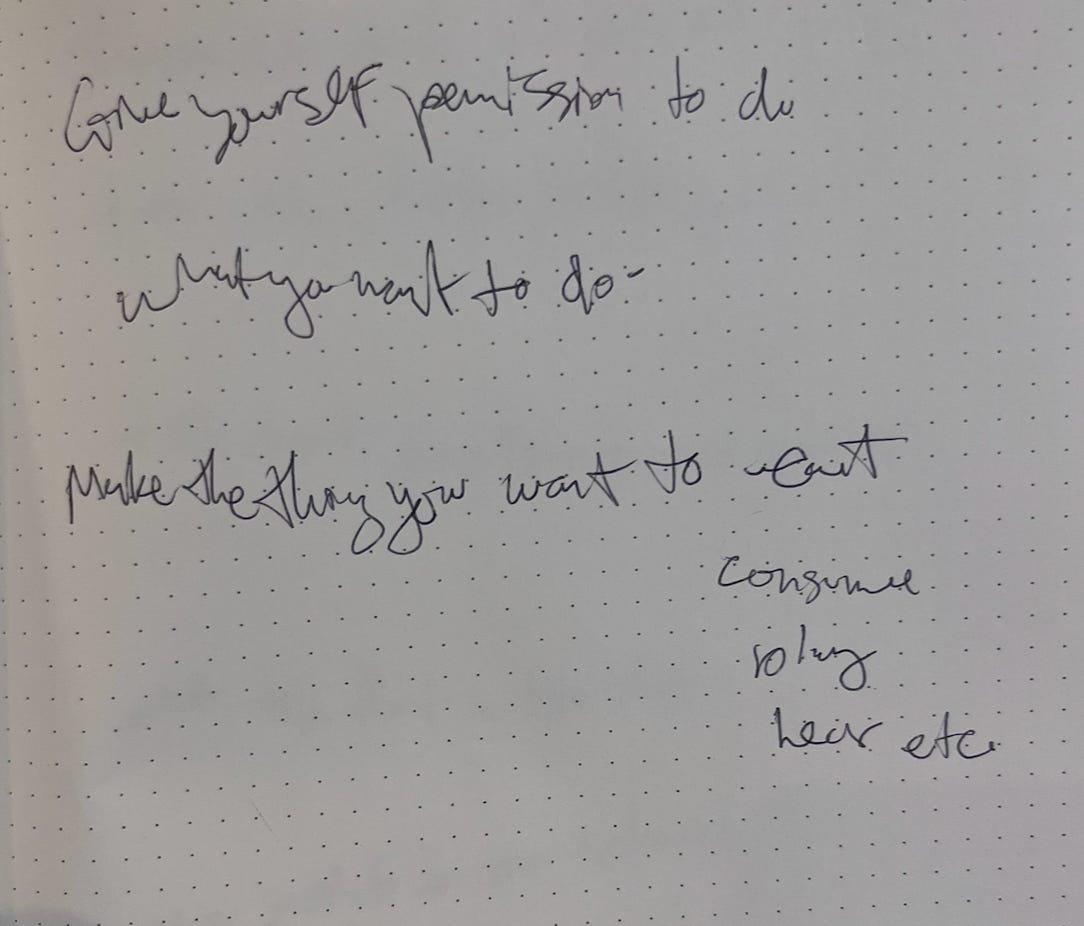
Afterwards, there was a second cup of medicine offered. I went up and spoke with S. I was going to tell her what happened, but I sensed she already knew. I nodded and she returned a knowing look. The only thing I could say: “It wasn’t about words.”
I considered taking a second cup and then realized I didn’t need more. I’d had enough.
As I walked back to my mat, I thought about Domingo. One day he’ll stop letting that other horse push him around. He doesn’t know his own strength yet. He’ll get there.
Wow.